• Home
  • Sign In My Account
Menu

Daily Do Good

641 S St NW
Washington, DC, 20001
Phone Number
Connecting kindness to communities, one person at a time

Your Custom Text Here

Daily Do Good

  • Home
  • Sign In My Account

Ghandi Brigade

June 13, 2016 Saranah Holmes
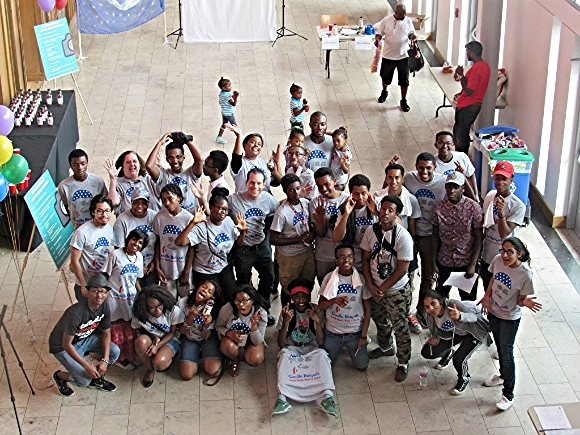
Volunteers smile for the camera

Volunteers smile for the camera

KEEPING GANDHI'S EFFORT ALIVE
GANHDI BRIGADE


Although often criticized, the media is one of the most powerful and effective ways to get a message across to the masses. The folks at the Gandhi Brigade understand that. Founded in 2005 by the late Richard Jaeggi, the nonprofit organization works to help young people in the Washington D.C. metropolitan area learn to use the media to promote the common good while becoming leaders in their communities. 

Gandhi Brigade works to honor and keep civil rights activist Mohandas “Mahatma” Gandhi’s “principles of nonviolence, awareness, and common effort” alive. The Gandhi Brigade consists of programs in which the volunteers learn how to master the following skills: public speaking, community organizing, art and graphic design, video production and photography. 

“We want to encourage young people to engage in community issues both from a local perspective and a global perspective,” said program director Ashley Simmons. “We also want to teach them media because this is definitely a tool that’s used to look at those issues. We don’t want to just talk about it; we want them to be active and [out there] doing things with media.”

Some of those issues include social justice, gender and sexuality, immigration reform, teen homelessness, and cyber civility and bullying. 

“I heard about Gandhi Brigade through my friends and when I would hear them talking about it, I instantly became interested,” said 16-year-old Satchel Young, a junior at Montgomery Blair High School. “As a volunteer, I have a few different jobs. I participate in the media activities, such as filming and editing [and I take] pictures as well. Also, I help promote Gandhi Brigade by passing out flyers and participating in major events.” 

Recognized as a leader in the field of youth led social change in the Washington D.C. metropolitan area, the Gandhi Brigade is not only designed to inspire young people to take a stand against social issues that matter to them but to uplift and empower them in their day-to-day lives as well. 

“[I love] making video projects on issues in our community,” said 16-year-old Mussie Fitsum, also a junior at Montgomery Blair High School. “It’s a great feeling to know that people will see the work that I did with my friends and see our opinions.”

“The biggest thing I learned during my time with Gandhi Brigade [is] that young people have a voice that needs to be heard,” Mussie said. “These youth groups like Gandhi Brigade can help you project that voice through your community using media.”


YOUTH MEDIA FESTIVAL
GANDHI BRIGADE


The eighth annual Gandhi Brigade Youth Media Festival took place on Sunday, May 31 at the Silver Spring Civic Center. The day-long event included a panel discussion on race, sexuality and religion, personal story and narrative films by area teens, and an art and photo exhibit. Area organizations, including Passion for Learning and Just Kids participated in the festival. Read a statement by executive director Evan Glass for Montgomery County Media here.

Unless otherwise indicated, the following photographs are from the Gandhi Brigade Facebook page: 

A film is shown at the Gandhi Brigade Youth Media Festival
A film is shown at the Gandhi Brigade Youth Media Festival

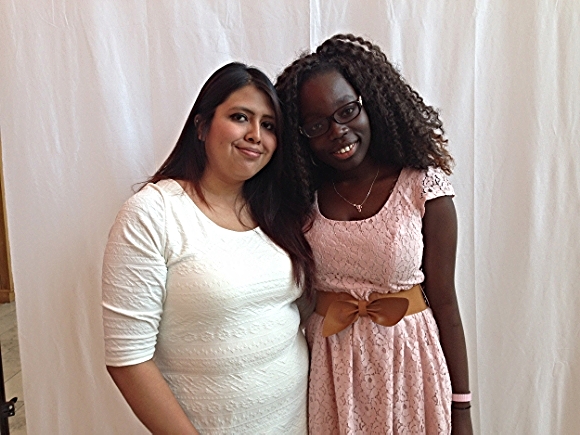
Noemi Sanchez and Prusse Kakpova, Gandhi Brigade youth mentors./Photo by Holly Leber

Noemi Sanchez and Prusse Kakpova, Gandhi Brigade youth mentors./Photo by Holly Leber

“We help youth to raise their voices” — Noemi Sanchez
Teens participate in a panel discussion

Teens participate in a panel discussion

Attendees view an art exhibit at Gandhi Brigade Youth Media Festival
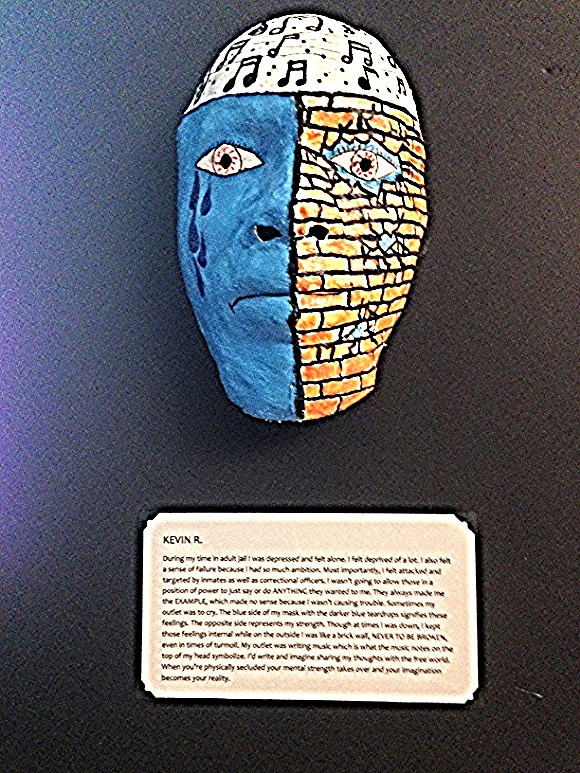
Attendees view an art exhibit at Gandhi Brigade Youth Media Festival

Mask created for Just Kids' Art with a Story, a project by nine young Marylanders who were charged as adults and incarcerated before the age of 18/Photo by Holly Leber

Mask created for Just Kids' Art with a Story, a project by nine young Marylanders who were charged as adults and incarcerated before the age of 18/Photo by Holly Leber

“What this is showing is how we felt when we were locked up” — Kevin, 23, charged as an adult at 15, came home at 19
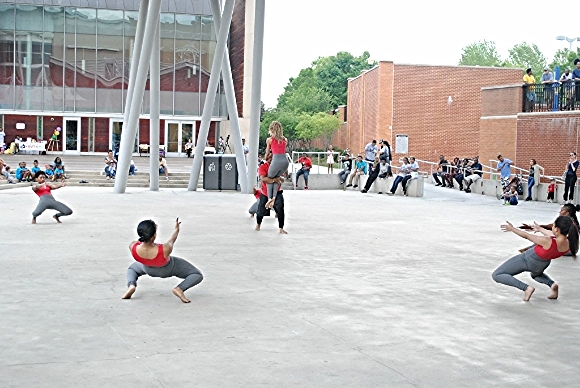
Dancers perform at Veteran's Plaza, Silver Spring

Dancers perform at Veteran's Plaza, Silver Spring

donate to ghandi bridge

About the Author: Princess Gabbara is a Michigan-based journalist and freelance writer (Ebony, Essence, etc.) You can read more of her work on her blog. She wasn’t aware that Gandhi was a member of the vegetarian society executive committee while attending University College London until now. 


In Youth/Education
Comment

Young Ladies of Tomorrow

June 13, 2016 Saranah Holmes
A YLOT participant receives a lesson in table setting and etiquette/Photo courtesy of Young Ladies of Tomorrow

A YLOT participant receives a lesson in table setting and etiquette/Photo courtesy of Young Ladies of Tomorrow

Young Ladies on a Mission to Succeed


Girls are the fastest growing population in the juvenile justice system, according to the Georgetown Center on Poverty, Inequality, and Public Policy. 

But, said Helen Wade, founder and CEO of Young Ladies of Tomorrow, Inc., their needs often go unmet. Founded in 1993, Young Ladies of Tomorrow exists to provide young women (ages 14-17) with the skills, support, counseling and empowerment that they need to transition into adulthood successfully.

Wade believes that the term “juvenile justice system” can be misleading. Although some of the girls are detainees, many of them have come to the courts in other ways.

“Some of the girls come from families that are in severe need. Some have been separated from their families,” Wade said. “And some have exhibited some behavioral or truancy issues at school. Each young woman is different.”

YLOT provides the young women with tutors, mentors, career development seminars, and field trips—to teach them new skills and to expose them to new opportunities.

Click here to see how YLOT is helping young ladies chart their futures.

SHE'S NO FAIRWEATHER VOLUNTEER


Stephanie Oboite and Sasha Bruce of The College of Dentistry at Howard University deliver a presentation on how to maintain good oral health./Photo courtesy of Young Ladies of Tomorrow

Stephanie Oboite and Sasha Bruce of The College of Dentistry at Howard University deliver a presentation on how to maintain good oral health./Photo courtesy of Young Ladies of Tomorrow

Shalamar Fairweather started to volunteer with Young Ladies of Tomorrow in 2014. 

“When I first began,” she said, “I would teach seminars and help students write narratives. Now we have fellows here and I am their supervisor.”

A native of Jamaica, Fairweather moved to the District a little more than a year ago. Now, she is an advocate for volunteer engagement.

“I think everyone needs to give back to their community," she said. "It’s really fulfilling. And you can gain a lot of skills from volunteering. My public speaking skills have increased since I started here. Plus, I have doubled up on my management skills.”

 YLOT offers numerous opportunities to volunteer—either working directly with the young ladies—or working behind the scenes. Here are a few opportunities:

1.     Love one-on-one interactions? Become a tutor!
2.     Enjoy engaging with small groups? Facilitate a workshop or become a mentor.
3.     Have extra space? Host a field trip or support an internship for a YLOT participant.

Young Ladies of Tomorrow work with DC Central Kitchen/Photo from DC Central Kitchen

Young Ladies of Tomorrow work with DC Central Kitchen/Photo from DC Central Kitchen

A DC native, fifteen year old Zatharia, also known as “Z,” has participated in the YLOT program for more than two years. She attends night school, where she is finishing high school.

Zatharia, also known as “Z”/Photo courtesy of Young Ladies of Tomorrow

Zatharia, also known as “Z”/Photo courtesy of Young Ladies of Tomorrow

What skills have you gained through the program?

We’ve searched for jobs, interviewed each other, resume writing. We have filled out job applications.

 What has YLOT taught you?

I learned to help others. I learned to make good decisions. I learned to think before I do something. I used to smoke and do drugs. I used to not come in the house and listen to my mother. Young Ladies of Tomorrow taught me how to be a young lady.

 What does the term “young lady” mean to you?

It is being respectful. Going to school every day. Not hanging with a bad crowd. Doing good things.

YLOT participants volunteered as ushers and hostesses at the DC Federation of Democratic Women’s Legislative Empowerment Summit, where they interacted with city officials./Photo courtesy of Young Ladies of Tomorrow.

YLOT participants volunteered as ushers and hostesses at the DC Federation of Democratic Women’s Legislative Empowerment Summit, where they interacted with city officials./Photo courtesy of Young Ladies of Tomorrow.

donate to ylot

About the Author: Chanté Griffin, an Older Lady of Tomorrow, is a writer and edu-tainer. You can catch her online at www.yougochante.com and @yougochante.

In Women, Jobs & Workforce
Comment

N Street Village

June 13, 2016 Saranah Holmes
Sharon Hart, community organizer; Gisele C.; Stuart Allen, chief development officer

Sharon Hart, community organizer; Gisele C.; Stuart Allen, chief development officer

HEALING A BROKEN SPIRIT


Gisele knew N Street Village’s doors were open to her.

She had come here before, in 1991, homeless and drug addicted. More than 20 years later, the demons got the better of her again.

“I came here not having anything except a broken spirit,” she said.

Since 1972, N Street Village has been serving DC-area women affected by homelessness. From a drop-in day center with activities, food and access to laundry, to recovery programs and permanent supportive housing, N Street Village serves nearly 1,400 homeless and low-income women each year, according to the organization’s website.

“N Street Village really is a toolkit,” said chief development officer Stuart Elizabeth Allen.  “Each woman who comes here every day uses the tools to rebuild her life.”

 The first goal, she said, is to establish a sense of trust. Despite the services available, some women might not be ready to ask for more than a meal and a place to sit quietly at first. Integration can be gradual: A meal, a conversation, a yoga class or art session at Bethany Women’s Center, N Street’s drop-in day program. Then, if needed, entry into addiction recovery, mental and physical health services at N Street’s Wellness Center, and moving toward permanent supportive housing, and independent living.

“For some women,” Allen said, “this is home. Their highest level of self-sufficiency is going to be where they need this wrap-around service. And that’s okay.”

When she re-entered N Street Village in 2013, Gisele spent two months moving between a shelter and the day program. She eventually began a substance abuse program.

Now, she said, she tries to set an example for ladies who are new to the program. “The sky’s the limit for Gisele,” she said. “This is a place I can rebuild myself and try to live my dreams.”

Dreams like staying healthy, going back to school to become a substance abuse counselor, and helping her 29-year-old son build his life.

“There were periods in his life when I was just missing,” she said, “but I don’t believe in throwing in the towel.”

The biggest hurdle to overcome, she said, has been forgiving herself. 


IT'S THE CLIMB


Street Village offers a sense of community, particularly for those who have been missing that.

“It’s something we all crave and need,” Allen said.

Walking the halls of N Street Village, women greet one another heartily and by name. Throughout the halls, clients’ art hangs on the walls.

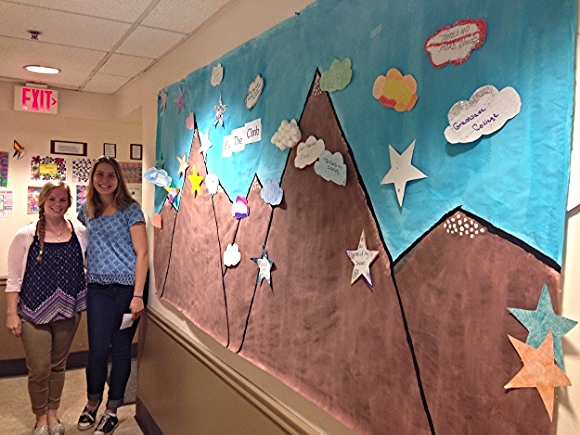
This past summer, interns Annabel Simpson and Devon Fore helped the women of N Street Village create a collage titled “It’s the Climb.” The work depicts mountains interspersed with stars and clouds. Written on the stars and clouds are goals and affirmations.


To keep my sobriety.
Become a mom.
Go to law school.
Graduate college.

Anything is possible, if only you believe.
There are no more clouds.

“The inspiration for me is recognizing the resilience of the women here,” said Devon, a peace building and development major at Eastern Mennonite University in Harrisonburg, Va.

“Some women think they aren’t creative,” said staff community organizer Sharon Hart, in a tone that expresses her disagreement with the sentiment. Referred to as the “heart of the village,” Hart has been on staff at N Street for 27 years. She oversees arts programs. The fruits of her labors can be seen everywhere.

A colorful cardboard butterfly hangs on the wall of Allen’s office. It symbolizes new beginnings.

A colorful cardboard butterfly hangs on the wall of Allen’s office. It symbolizes new beginnings.

N Street’s own beginnings can be found at Luther Place Memorial Church, across the street. Forty-three years ago, members of the church helped offer a place for homeless people to lay their heads at night – a series of mats on a floor.  Now, more than 200 women each night have a safe place to sleep.

Luther Place still serves as a night shelter and maintains a close relationship. Once a week, Rev. Karen Brau, pastor at Luther Place, leads the N Street Choir in song.

The choir recently performed at the swearing in of Michael Botticelli, director of the White House Office of National Drug Control Policy, or as anyone in the position is informally known, the drug czar.

Like many of the women at N Street Village, Botticelli himself once struggled with drug abuse. According to an April New York Times article, his goal is recovery, not punishment.

“Locking people up for minor drug offenses, and especially people with substance-use disorders, is not the answer,” the Times article quotes him as saying. “It’s cruel. It’s costly. And it doesn’t make the public any safer.”

N Street Village also cottons to this particular hands, not handcuffs, philosophy. Stuart Allen tells of a client who was sober for nine years, then relapsed. She began the climb back up the proverbial mountain, and tumbled down again.

“People are always looking for the success stories, “ Allen said. “But this is why we’re doing this. Women are going to move on, and N Street village is always going to be there. When (a relapse) happens, N Street village is always going to be there. That was a day I was like, ‘thank goodness we’re here.”

donate to N street village
In Hunger/Homelessness, Women
Comment

Painting Out Poverty

June 13, 2016 Saranah Holmes

ART AS A COMMON LANGUAGE


Two years ago in Austin, Tex., Paulina Sosa and a group of painters wondered how they could use their art to bring attention to the issue of urban poverty. Their aim was to bring together allies and inspire action against homelessness and hunger, rather than depress people and make them feel hopeless. They formed a collective called Painting Out Poverty  to work on this problem.

But last fall, Sosa moved to Washington, DC to start her Master of Public Health at George Washington University. End of the group, right?

Wrong. Just the beginning.

As if a five-class courseload, three jobs and a health internship at the World Health Organization weren’t enough to keep her busy, Sosa launched POP in Washington, DC. The group landed a Knapp Fellowship for Entrepreneurial Service-Learning, a grant established by GWU to support social entrepreneurs who want to have an impact on the DC community.

“The arts are a common language that can have a healing effect, both on the people who are creating it and those who are receiving it,” said Sosa. The group capitalizes on the unifying effect of the arts to bring people together in a positive setting to advocate for anti-poverty policies. The artists benefit as well, says Sosa. “It gives them a platform to work with the community on socially conscious initiatives.”

Now, just a year after Sosa touched down, POP’s network of visual artists has expanded to include writers, musicians and an impressive array of community arts organizations. Its first event was a March fundraiser and book drive in conjunction with Reading Partners. And that was just the beginning. 

THE HEALING POWER OF ART


On Aug. 15, Painting Out Poverty hosted a day-long kick-off at the Westminster Presbyterian Church around the theme “The Healing Power of Art.” The work of local artists adorned the walls, and representatives of organizations such as Street Sense, Fuerza Contra Alzheimer’s and the Capitol Hill Arts Workshop sat ready at tables to discuss how their organizations use the arts to combat poverty and illness.

One of the attendees was too big to fit inside the venue: A bus, painted white with gold dollar accents, sat in the parking lot outside. I Have a Home Here is a mobile, community-based art installation meant to illustrate the realities of poverty in the city. In a previous installation the bus was rendered invisible, representing the invisibility of the homeless. Future plans include creating a temple to homelessness in the interior of the bus, and making it a base for an interactive game of Homelessopoly, where players move around the board with backpacks, cardboard boxes and shopping carts, and give donations to Street Sense to get out of jail.

Back in the church, the day’s program began with an all-star panel, moderated by Juanita Hardy, Executive Director of Cultural DC, in which representatives from the DC Commission on the Arts and Humanities, Will Rap 4 Food and Town Hall Education Arts Recreation Campus (THEARC) joined CHAW, Fuerza Contra Alzheimer’s and the pastor of Westminster Presbyterian to discuss how artists and arts organizations can empower people, develop communities and transform lives. 

THE FUTURE OF POP


“Art has a role to play in addressing poverty, alienation and marginalization,” said Pastor Brian Hamilton. “For arts to be transformative, we have to get to the places where people don’t see themselves as being part of the arts.”

Navada Taylor of Will Rap 4 Food agreed. “Everyone on this panel knows that the arts community really sets the tone of what happens in society. If we intentionalize that, we can change society.”

Hardy provided the business case for the arts by detailing how arts centers have created jobs and led to economic development in communities like H Street and Columbia Heights.

The panel members were not alone in testifying to the healing power of art. James, a writer and vendor at the Street Sense table, described the arts as therapeutic. They relieve stress and helped him work through depression. “I could tune out the rest of the world and just concentrate on writing that poetry and creating that art.”

Artist: Raven Cain

Artist: Raven Cain

In his eyes, the art workshops Street Sense offers are essential. “For our vendors it really makes a difference in their lives. Dealing with homelessness and poverty, it really helps to give them somewhere to go and give them an outlet.”

So what’s next for Painting Out Poverty?

Sosa says POP will partner with local organizations on painting and writing workshops in schools to empower students to tell their stories. She envisions a journal of short stories and poems about poverty, hunger and homelessness to raise awareness of how these issues affect children.

Another project Sosa has in store is to enlist graffiti artists to create a mural as a joint effort with community members, who would not only help design the work, but would also participate in the painting process.

become a pop partner

About the Author: Tara Campbell is a DC-based writer of crossover science fiction. Formerly a painter, she’s now content to stand back and write about people who can really wield a brush.

In Art, Hunger/Homelessness
Comment

Dreaming Out Loud

June 9, 2016 Saranah Holmes

“WHEN DREAMS EMERGE, COMMUNITIES ARISE”


As far back as human history, food has functioned as a magnet, bringing families and communities together. Access to healthy, nutritious food has always been paramount for maintaining a well-balanced diet and longevity.  Unfortunately for many families who live in low-income urban areas, finding local fresh produce remains a challenge. 

Dreaming Out Loud, a D.C. nonprofit founded in 2008, believes in the power of food to “feed the dreams of all people and build more resilient communities.”

The initial goals focused on bridging the educational and economic gap in under-served communities, working in Ward 7 to provide leadership and character development to school-aged children.

“There is a huge utility in teaching core values to kids — it changes their lives,” said founder and executive director Chris Bradshaw. “We started to notice a lot of issues stemming from food that impacted our ability to run a successful program.”

Indeed, without access to fresh foods, neighborhoods end up facing severe and long-lasting health issues, which can span generations. According to the National Housing Institute, access to affordable, nutritious food is “an essential component of a livable and well-functioning community…and can enhance their broader economic and social health.”

“In kindergarten through third grade, kids were being fed sugary snacks and then would have no attention span after school,” Bradshaw said. “In high school-aged kids, we saw an evolution of the same issues. There was a lack of access in the community to healthy foods.”

After realizing that many of the social issues they were fighting stemmed from the same source, the “consequential issues surrounding food systems and economics in our partner communities,” DOL pivoted towards its current mission of building food equity. Bradshaw and colleagues believe all communities need and deserve equal access to healthy food choices.

They launched Aya Community Markets, a “growing network of farmers markets that help to provide access to fresh, local produce, spur economic development, and build health equity,” according to the DOL website.

Aya Community Markets use both the traditional farmers market model and mobile farm stands to extend their reach as wide as possible.

In 2014, more than 10,000 people benefitted from Aya Markets, and more than 70,000 pounds of fresh, local produce were distributed. Dreaming Out Loud pairs with an anchor farm partner, Crazy Farm, in Westmoreland County, Va. In 2015, Bradshaw and company aim to reach 30,000 people.

“Aya” is Ghanian for “the fern.” Bradshaw traveled to Ghana in 2011, and was inspired by the farmers markets of Ghana, which simultaneously support farmers and communities.

“We see the food system as a way to bring communities together and strengthen them,” he said.


Q&A WITH CHRIS BRADSHAW, EXECUTIVE DIRECTOR OF DREAMING OUT LOUD


1.   Have you experienced any challenges with trying to bring healthy eating habits into the lives of communities and families that aren’t necessarily used to doing so?

It is a challenge to get people used to the idea of healthier eating. It helps that awareness of the issue has grown substantially in recent years, especially with  Michelle Obama, the White House garden and the Let’s Move! campaign. People are more willing to try new things and get involved. It’s great to see the interest grow. We now have two markets and a garden space. I can feel the growth in the city and people becoming more aware… it feels like we are bridging the gap between desire and lack of opportunity. 

2.    Tell me more about the idea to use Adinkra symbols.

The Adinkra symbols are our organization’s core values.  They’re a way to take stock of the foundational elements of our broader teaching philosophy. How do you instill a value-based approach to your work? It also involves instilling performance values for how you conduct yourself. They are the compass for our work.

3.    Can you tell me about a specific time or instance in which you felt your mission was a success?

The instance when I felt our mission was being exemplified most was at our farmer’s market. Just hearing people come up and say how thankful they are for the market and the availability of produce and how much it helps them. I remember once last year a woman came up to me and said, “I’m so glad you this is here, this is helping me deal with my HIV and sickle cell.” That was a really touching moment for me. To have both of those diseases and to not have access to ways to maintain your diet — I couldn’t believe it.

4.    What is something you’ve taken away from your work with Dreaming Out Loud?

It’s taught me the idea that everybody’s opinion and value is unique and that you have to take the time to understand someone’s value and uniqueness.  What someone brings to your life and to your world is not always obvious.


ADDITIONAL PROJECTS AND COLLABORATIONS


Project Dream Green

In 2010, Dreaming Out Loud, in cooperation with Groundwork Anacostia River DC, developed and implemented “Project Dream Green,” a youth employment and training program. Participants aged 14-21 participated in environmental projects including energy conservation and maintenance of parks and trails.

Aya Accelerator

The AyaAccelerator is designed to help micro-entrepreneurs whose mission accords with that of Dreaming Out Loud. By partnering with both funding platform Clovest and Kiva Microfunds, DOL is able to provide even more opportunities for youth to “dream out loud.”

Aya Youth Cooperative

The Aya Youth Cooperative builds off DOL’s initial mission of character and leadership development by striving to provide a space for youth to gain work, entrepreneurial, and service skills.

DOL has established an urban farm at Blind Whino, which will allow 12 youth participants to gain valuable skills and development.

Produce Plus Program

In a blog post about the community partnerships, Bradshaw cited PPP as the key to much of the success DOL saw in 2014. The program helps District residents who are recipients of federal assistance programs by providing them with $10 per household per week to spend on fresh fruit and vegetables at the farmer’s markets. PPP functions as an incredible way to give access to fresh produce for low-income communities.

More DOL projects and collaborations here….

donate now

About the Author: Marisa Weidner is a graduate of The College of William and Mary. She has volunteered as a teacher in Belize, and in homeless shelters in the United States. Marisa chronicles her explorations of DC on her blog, The Curated City. 

In Youth/Education, Health/Mental Health
Comment

Global Kids DC

June 9, 2016 Saranah Holmes

LEARN, LEAD GLOBALLY


“I like to know what’s going on in the world,” said Khadijah, a student from McKinley Technology High School. That’s what attracted her to the DC Summer Institute, a six-week international affairs program organized by Global Kids’ Washington, DC Program.

A New York and DC-based organization, Global Kids gives youth from underserved areas the knowledge, skills and experiences they need to succeed in school and become leaders in their communities and the world.

The Summer Institute, said Wida Amir, director of Global Kids DC, “connects the disconnected young people to the best of what Washington has to offer.”

Most DC-area participants are from Wards 7 and 8, where high school graduation rates are below 50 percent. The overall graduation rate for Global Kids participants, on the other hand, is 99 percent. 

Khadijah was looking for a program where she could meet new people and travel—and the Institute is delivering. Talking with Australian students at the Australian Embassy has been one of the highlights so far, she said, as has getting to know the other students in the program too.

“The people in the program make it what it is,” she said.  

Although she isn’t looking forward to the long plane trip ahead, Khadijah is eager for the opportunity to see South Africa firsthand and “get past stereotypical ideas of what a place might be like.”


MINIONS AND DRAGONS


Wait, wait, hold up: South Africa? 

Yes! The capstone experience of the GK (Global Kids) DC Summer Institute is an international service-learning project. This year, fifteen students will travel to South Africa in early August to partner with organizations such as SA-Yes Youth Mentoring, a program that assists young people aging out of children’s homes and transitioning to independence. Additional areas the Summer Institute cohort intends to explore are racial and economic justice and LGBTQ rights.

But hang on, I’m so excited about South Africa I’m getting ahead of myself again. Let’s back up even further. 

Each summer, 25-30 DC-area teens participate in the Institute. Students normally find the program via its partnership with the Marion Barry Youth Leadership Institute, a program of the DC Department of Employment Services. The Summer Institute is classified as a job site in the District’s Summer Youth Employment Program, which means participants don’t have to choose between earning money now and preparing for a global career in the future.

Most mornings in the program start with a discussion of current events, followed by games and activities introducing central concepts and issues in international affairs. On a June afternoon, students engaged in a lively discussion about the history of the black and LGBTQ rights movements, inspired by a “Democracy Now” headline and buzz about a petition to replace the Confederate flag with a rainbow flag. 

After that, a boisterous game about trade and globalism: The Incredible Minions battled the Black Dragons to be the first to identify the company, and countries of origin and manufacture of products such as iPhones, Air Jordans, and Beat headphones. Turns out these kids are as good at tracing global manufacturing paths as they are at picking awesome team names.


SERVICE AND STOWAWAYS


Other Global Kids program features include guest speakers from organizations such as the State Department and World Bank, and field trips to visit embassies, Capitol Hill, or companies like KPMG.

Kela, a Summer Institute participant from Benjamin Banneker High School, went into the program with specific goals.

“I wanted to work on my communication skills,” she said. “And leadership skills. And foreign policy.”

Listening to State Department employees inspired Kela, who can now imagine a similarly “nomadic” future.

The DC-based portion of the program lasts four to five weeks, followed by a one- to two-week overseas service-learning project—all costs included.

“Normally we’re able to raise funds to send eight to ten participants overseas,” said Amir. “But this year, thanks to a grant from the Department of Employment Services, we’re able to send fifteen.”

At the mention of South Africa, Kela breaks into a wide smile. She’s eager to explore the country’s traditions, culture and history. Her family and community are excited for her as well, raising funds for personal expenses and offering to come with her in her suitcase. 

“It’s helpful to learn about what’s outside your own neighborhood,” she said. “(The GK Summer Institute) opens your mind so you can make connections with other communities.” 

donate now

Tara Campbell is a DC-based writer of crossover science fiction. She would love to join the South Africa-bound party in Kela’s suitcase. 


In Youth/Education
Comment

Shout Mouse Press

June 9, 2016 Saranah Holmes

SHOUT MOUSE PRESS: TELLING UNTOLD STORIES


Meet Mariah.

Mariah is blind. She runs a fruit stand – with a little help from her parrot, Blue.

She is the star of “Mariah Finds A Way,” a book from DC’s Shout Mouse Press.

“(Mariah) overcomes (her blindness) by using her other senses,” said one of the book’s authors, Darrin Gladman. “There was a Santa Claus dude who was stealing fruit and the bird went to the police.”

Shout Mouse Press is a “writing program and publishing house with a mission to make unheard voices heard.” Working with other nonprofits in DC and Haiti, executive director Kathy Crutcher and her colleagues coach minority children to write, publish and promote their own stories.

 Darrin, 15, said writing children’s books has made him more creative.

“I discovered a sense of accomplishment and relief,” he said.

 Many Shout Mouse Press authors are also tutors for another DC non-profit, Reach Incorporated. Reach pairs struggling teen readers with elementary-age children who are below grade level readers.

Shout Mouse Press authors iron out plot lines.

Shout Mouse Press authors iron out plot lines.

 Several years ago, the older students went to Reach executive director Mark Hecker with a problem: Very few of the books portrayed people of color like themselves. “We can write books better than these,” they told him.

 “I bet you can,” he responded.

 Hecker approached his friend and fellow Duke University classmate, Crutcher. She had a decade of experience mentoring young writers, so she was prepared for the challenge.

 “Can we make this happen?” Hecker asked.

 And, thus, Shout Mouse Press was born.


YOUR STORY MATTERS


As young children learn to read they’re often drawn to stories about children much like themselves. Yet when non-white children crack open a book, most of the time, the stories they see are the stories of white kids.

 In 2014, the Cooperative Children’s Book Center at the University of Wisconsin-Madison School of Education conducted a study of 3,500 newly published books and found that only 11 percent featured minority characters prominently. Contrast that with our present-day racial make up: almost 50 percent of children under the age of five are non-white.

Shout Mouse writers at DC Author Fest

Shout Mouse writers at DC Author Fest

 How much harder must it be for kids to develop a love of reading if the stories they read are hard to relate to?

 Is it any wonder that many minority children grow up feeling like their stories don’t matter to the larger world?

“We have made a commitment to always believe the kids can do more and they always prove us right,” Crutcher said.

Some people might think that below grade readers are unlikely authors. However, Crutcher said, because of the multitude of stresses in their schools, these kids are often victims of low expectations.

Shout Mouse has also worked with teen writers at Ballou High School to create memoir collections geared toward teen readers. Their stories share the challenges of growing up in tumultuous and sometimes frightening environments.

M.S. Holiday (a pen name) contributed to the first memoir, "How to Grow Up Like Me.” Her essay, “17 Lessons,” is about what she learned growing up in a physically abusive home. She often wished she could protect her mother from further abuse. Schoolwork, she said, was her refuge.

 “People say to follow your heart,” she wrote, “but I don’t want any emotions wrapped up with what was already happening so I just had my knowledge.”


THE RIPPLE EFFECT


Ashley Cooper, 17, is one of the authors of “The Hoodie Hero,” a story about a young man modeled after Trayvon Martin. She said the discussions with other teen authors made her think about self-reliance.

“You’re going to have to make decisions on your own and think for yourself,” she said. “Mom and Dad are not always going to be there for you.”

 Shout Mouse Press books are now available in every DC public school library. Copies have been ordered for all branches in the DC public library system.

Some of Shout Mouse’s partner organizations have global networks. Readers in more than a dozen countries enjoy Shout Mouse Press books, according to the organization’s Facebook page.

 Imagine the joy of an underserved child, unaccustomed to reading stories about children like herself, learning that children in France are reading a book she wrote.

 The ripple effect continues closer to home as Shout Mouse authors’ classmates learn of their comrades’ achievements. This changes how minority children see themselves, and what they believe they are capable of.

 Ashley got a surprise taste of celebrity authorship while she was walking to school one day. She heard a young child who had read “The Hoodie Hero” call out to her friend:

 “Hey that’s Ashley. She wrote the book.”

donate now

About the Author: Terri Carr is a Washington, DC yogi and writer. She blogs at Yoga Soulutions. 

In Youth/Education
Comment

Room to Rebloom

June 9, 2016 Saranah Holmes
A Room to Rebloom home

A Room to Rebloom home

ROOM TO REBLOOM GIVES DOMESTIC VIOLENCE SURVIVORS SECOND CHANCE


What do interior design and domestic violence have to do with each other? Well, imagine starting from zero, rebuilding your life and then creating a whole new space for your new life.

Since 2012, the hardworking people at Room to Rebloom have been doing just that for domestic violence survivors and their families in the Washington metropolitan area. Founded by Enid McKitrick, the nonprofit works to empower low-income women, who’ve been victims of domestic violence, through interior design. Their motto: “Design. Heal. Grow.”

“We’ve given [the women] a sense of purpose when it comes to their home, a sense of commitment [and] dedication to something that’s new and different,” said volunteer interior designer Kia Weatherspoon. “This type of dedication to one thing, to their own space that’s clean, thoughtful and has a purpose – I think that’s really changing their lives.”

At Room to Rebloom, it’s about more than redesigning homes – it’s about creating spaces, where women can go to feel safe, in control, and strong enough to stand on their own two feet. The clients are involved throughout the entire design process so they feel a sense of ownership.

“I wanted to bring empowerment to a group of people who were very disempowered and the obvious choice was domestic violence survivors,” McKitrick said. “We want these women to feel that they’re worthy of having beauty in their lives.”


STRIVING FOR BETTER


To become a client of Room to Rebloom, the women must already have their own housing, whether it’s a one-bedroom home or an apartment. Furthermore, they must be referred by an organization or program that provides domestic violence survivors with emergency and transitional services and other resources that may come in handy during this difficult time in their lives.

“Without these services, many women end up returning to the abusive relationship, and we need to be sure that a client is stable before we can invest our resources,” McKitrick said. “Once she’s ready for independent housing and has found an apartment, that’s when she is referred to us and we assign one of our designers to work with her.”

Room to Rebloom design includes inspirational quotes

Room to Rebloom design includes inspirational quotes

Part of Room to Rebloom’s success has to do with the fact that several companies donate furniture, home décor, paint and other much-needed materials. The companies include Ikea, Sherwin Williams, House of Ruth, and the American Society of Interior Designers.

In a way, the newly-designed homes serve as the final step for these women to be able to go on and live the life they’ve always wanted and more importantly, the life they deserve.

“Everyone deserves good design. And the people who need it the most don’t know they don’t have well-designed spaces, they don’t know how to ask for it and they don’t get it,” Weatherspoon said. “You can’t put a dollar amount on how creating these spaces can make people [want to] strive for something better just by putting them in an environment that’s outside their norm.”

donate now

About the Author: Princess Gabbara is a Michigan-based journalist and freelance writer (Ebony, Essence, etc.). You can read more of her work on her blog. She also tweets @PrincessGabbara.

In Women, Art
Comment

Young Playwrights' Theater

June 9, 2016 Saranah Holmes
YPT founder Karen Zacarias/Source: YPT Facebook page

YPT founder Karen Zacarias/Source: YPT Facebook page

FROM PAGE TO STAGE:
YPT HELPS DC YOUTH FIND THEIR VOICES


The only professional theater in DC dedicated entirely to arts education has an ambitious mission: To inspire young people to realize the power of their own voices.

Karen Zacarías founded Young Playwrights’ Theater in 1995 out of a desire to use her experience with art to positively impact her community. Since then, the program has exploded. YPT has produced more than 350 plays and reached more 13,000 students, performing for nearly 100,000 people across the DMV.

YPT Student Advisory Committee/Source: YPT Facebook page

YPT Student Advisory Committee/Source: YPT Facebook page

YPT works directly with students in schools in the DMV through its large array of program offerings. “I got my start with them when they came to my school through the In School Playwriting Program when I was in middle school,” said Nana Gongadze, a YPT alumna. “A play I wrote – ‘The Alligator Summer,’ a comedy about kids looking for a summer job - was chosen as part of the New Play Festival.”

Through playwriting, YPT “develops students’ language skills, and empowers them with the creativity, confidence, and critical thinking skills they need to succeed in school and beyond,” according to the organization’s website. YPT’s vision is to seek social justice by empowering all students, especially those who from underserved areas, to value their own voices and opinions.

"YPT (helped) me realize that I could be more than I already am,” said Anna Vargas, another YPT alumna and current member of their Student Advisory Council. “I’d never done creative writing before — I didn’t think I could write as well as some of my friends. YPT has helped me believe in myself.”


CATCHING THE PLAYWRITING BUG


YPT runs several different types of programs throughout the year: both in-school and after-school programs, a summer writing workshop, and the Young Playwrights’ Workshop. In addition, YPT also collaborates periodically with theaters, museums, and other institutions to create works that are relevant to current events. 

Each in-school program culminates in the New Play Festival, an annual “celebration” of the voices of YPT’s students. YPT chooses several plays from its group of students and partners each writer with professional actors and directors to put on their plays in front of a public audience. The 2016 festival will take place at three different venues in DC over the course of three weeks in April.

Image from YPT production "One in the Chamber."/Photo source: YPT Facebook page

Image from YPT production "One in the Chamber."/Photo source: YPT Facebook page

“Seeing my play performed was the best part [of the program]. It was so cool to see how the play had come so far, and the creative choices that were made… I had never written a play before then, and the experience definitely made me catch the playwriting bug. I've been writing them ever since,” said Nana.

YPT’s upcoming performance, “Girls Write Out!” is coming to DC on Monday, October 19th, at the Forum in Sidney Harman Hall. Featuring four plays written by YPT student playwrights age 8-15, the production is part of the Women’s Voices Theatre Festival.


EXPANDING ARTS EDUCATION


YPT’s model of teaching has garnered attention from media across the nation, and the organization has won numerous awards, including the prestigious National Arts and Humanities Youth Program Award from the President’s Committee on the Arts and Humanities in October of 2010.

The award was presented to YPT by First Lady Michelle Obama, and solidified the importance and success of YPT’s work with students.

“We all went to the White House and were asked specifically if we could bring a student,” said executive director Brigitte Taylor. “One of our students, Marianna, had written a play about missing her mom. It was so simple and beautiful. She got to go on stage and talk about her work and her experience in front of all these people, including Michelle Obama. She also got to call her mom from the White House. Anytime that I’ve been able to see the path a young person takes from beginning to end like that has just been so meaningful.”

In the future, YPT hopes to expand to even more schools across the area and reach even more students. “A lot of people are drawn to arts education—I knew that it was important because of the meaning of the arts in my own life, but it wasn’t until I saw that transformative power in these students that I really understood the meaning and power of the arts. I want to make sure every student is successful,” said Brigitte.

“I’ve learned the importance of being young and needing a creative outlet,” said Shelby, a YPT volunteer. “It gives kids the opportunity to trust their own ideas and tells them that what they think and say is important. The mission is amazing. As I was working more and more with the kids, I discovered how important their voices are, and especially how important it is to give a voice to youth in underserved areas.”

YPT student Mariana with then-CEO David Andrew Snider and First Lady Michelle Obama, 2010/Photo Source: Young Playwrights Theater

YPT student Mariana with then-CEO David Andrew Snider and First Lady Michelle Obama, 2010/Photo Source: Young Playwrights Theater

donate now

About the Author: Marisa Weidner is a graduate of The College of William and Mary. She has volunteered as a teacher in Belize, and in homeless shelters in the United States. Marisa chronicles her explorations of DC on her blog, The Curated City. 


In Youth/Education, Art
Comment

RFK Human Rights & Speak Truth to Power

June 9, 2016 Saranah Holmes
Robert F. Kennedy (then U.S. attorney general) addresses demonstrators in front of the Justice Department, June 14, 1963/Photo credit: CBS News

Robert F. Kennedy (then U.S. attorney general) addresses demonstrators in front of the Justice Department, June 14, 1963/Photo credit: CBS News

Editor's note: Our founder, Saranah Holmes, is especially excited about this featured organization because of her personal connection. She spent almost eight years employed by RFKHR in the positions of Executive Assistant and Online Auction Manager. Saranah continues to work with RFKHR as a consultant. She is grateful for all of the support she received when she decided to venture out and start the Daily Do Good, and will always consider RFKHR family.


ROBERT F. KENNEDY: A LEGACY


In her first year teaching high school psychology, Fairfax County, Va. resident Katie Gould led a short unit on serial killers.

“Not my favorite,” she noted.

To balance the scales, she asked her students to name people who exhibited the exact opposite characteristics.

“It got really quiet,” she said. “They had just rattled off five serial killers, and they really didn’t have anyone they could come up with.”

Around the same time, her father, then research director at the American Federation of Teachers, mentioned the Robert F. Kennedy Center for Justice and Human Rights (now known as Robert F. Kennedy Human Rights).

“There’s an incredible organization,” he told her.

“I was looking for this hole to fill,” Gould said, “and I came across the curriculum for Speak Truth to Power online, and was absolutely delighted.

Speak Truth to Power is one of several programs at Robert F. Kennedy Human Rights. Founded in 1968 by Ethel Kennedy, the mission of RFK Human Rights is to continue Robert F. Kennedy’s legacy of fighting human rights injustices.

“Everything we do is geared toward realizing the legacy of Robert Kennedy,” said John Heffernan, executive director of Speak Truth to Power. “It’s about creating a citizenry dedicated to holding society to the highest standard of equality and justice. It’s about abandoning the role of bystander when it comes to human rights abuses.

Speak Truth to Power evolved from the book of the same name written by Kerry Kennedy, daughter of Robert and Ethel Kennedy, and president of RFK Human Rights. Featuring interviews with 51 human right activists and defenders, the 2000 tome spawned a photo exhibition and a play, which has been performed worldwide by renowned actors including Meryl Streep, Julianne Moore and Sean Penn, among many others.

But perhaps the most vital offspring of Kerry Kennedy’s book is the Speak Truth to Power curriculum.


SPEAK TRUTH TO POWER:
IN THE CLASSROOM AND BEYOND


Click on the image to link to a video, interview or lesson

Click on the image to link to a video, interview or lesson

Joseph Karb, a middle school social studies teacher in Springville, NY, is one of the educators who helped develop the STTP curriculum. He said one lesson he wants to impart to his students is that human rights advocacy doesn’t begin “over there.”

“I want them to leave with an understanding that there are human rights issues around the world,” he said, “and internalize the role of the defender, so when they have the opportunity, they are going to stand up for someone else.”

This word, defender, is key to the STTP program. Karb defines it as “standing up for others, sometimes at personal risk.” Defenders featured in Kerry Kennedy’s book, and as part of the curriculum include The Dalai Lama, Elie Wiesel, Archbishop Desmond Tutu, President Jimmy Carter, Malala Yousafzai and Nelson Mandela.

Click on the image to link to a video, interview or lesson

Click on the image to link to a video, interview or lesson

Christopher Buckley teaches high school American history and contemporary issues in Darien, Conn. He facilitates Speak Truth to Power leadership training with teachers: “We talk about educating the whole student and teaching students the importance of empathy and standing up for your conviction,” he said.

In his own classroom, Buckley has created what he calls the Ripple of Hope Project, inspired by RFK’s speech on apartheid, at the University of Capetown in 1966. Students examine the underlying tenets of the speech, and study STTP defenders as well as laureates who have won the Robert F. Kennedy Human Rights Award.

Part of the project is figuring out how high school students can be active participants.

“A suburban kid from Darien isn’t going to go rescue a kid out of the Congo, but what can they do,” Buckley said. “It’s about students becoming more aware of their surroundings and the impact their action has.”

After learning about LGBT activist Jamie Nabozny, Joe Karp said, a group of his students decided to launch an anti-bullying club. Some of Katie Gould’s students started a community garden after studying farmworkers’ rights and defenders like Librada Paz. Her students were invited to watch Paz receive the 2012 RFK Human Rights Award.

“The kids aren't just reading about some perfect person on a textbook,” Gould said. “Speak Truth to Power humanizes these folks who are total rock stars. I know it transformed not only the way (my students) saw the world, but it gave them a new perspective on how they saw themselves. It made them feel like 'why not me'?”

Students with Librada Paz (holding her Robert F. Kennedy Human Rights Award/Photo contributed by Katie Gould

Students with Librada Paz (holding her Robert F. Kennedy Human Rights Award/Photo contributed by Katie Gould

SPEAK TRUTH TO POWER:
ACTION AND INSPIRATION


The Speak Truth to Power program also provides students with the opportunity to engage in human rights through media via music and video contests.

“Kids learn in different ways,” said Heffernan “What better way to get these kids interested in academics and to show they can make a difference. (These works) create empathy.”

RFK Human Rights leads the video contest in cooperation with the American Federation of Teachers and the Tribeca Film Institute. The grand prize winning video is screened at the Tribeca Film Festival in New York.

RFK Human Rights Speak Truth To Power www.speaktruthvideo.com 2015 - Grand Prize Winner Bloomfield Tech - Bloomfield, NJ Another Look at Genocide

Following a unit on the muckrakers of the Progressive era, Joe Karb leads his students in the creation of a short documentary, focused on a modern day defender. A group of his students had the opportunity to speak via Skype with 2014 Nobel Peace Prize winner Kailash Satyarthi about his work fighting child labor.

Kailash Satyarthi with former child slaves in India/Photo credit: The BBC

Kailash Satyarthi with former child slaves in India/Photo credit: The BBC

“For some of the students,” he said, “it’s really transformative for them. We live in a pretty rural, isolated area. It’s easy to think in terms of numbers, not personal stories. When they hear the stories of people who stood up to others, it’s changed their outlook on life, they realize the world is a big place.”

The video contest, he said, challenges students to create something that can inspire others to action. “In a way, they’re becoming modern muckrakers themselves.”

Speak Truth to Power has helped educate and inspire countless young people to action, from the students who learned about child labor in cacao fields and launched a “reverse trick-or-treat” project, in which they distributed fair trade chocolate and informational cards in their neighborhoods, to the high school junior who was on the verge of dropping out before he became involved with the creation of an STTP video about Wangari Maathai, who created the Green Belt Movement to fight deforestation in Kenya. That video, from the Washington-Saratoga-Warren-Hamilton-Essex BOCES school in upstate New York, won the grand prize in the STTP video contest in 2012.

“I am convinced that by education,” Heffernan said, “we can prevent human rights abuses if we bring together students who can form a citizenry that holds their governments accountable.”

In the words of Robert Kennedy: “Few will have the greatness to bend history itself; but each of us can work to change a small portion of events, and in the total; of all those acts will be written the history of this generation.


ADDITIONAL PROGRAMS & AWARDS AT
ROBERT F. KENNEDY HUMAN RIGHTS*


RFK Compass - Engaging the investment community at the intersection of business and human rights.

Partners for Human Rights - Our lawyers and experts join with our partners in the field to create real change, fulfilling Robert Kennedy’s pledge that those with the courage to enter the moral conflict will find themselves with companions in every corner of the globe.

RFK Young Leaders - Robert Kennedy called young people “the world’s hope.” He believed in their energy, talent, and idealism — qualities that define the RFK Young Leaders, a group of innovative, influential, and philanthropic young adults dedicated to creating a more just and peaceful world.

Health eVillages - Bringing lifesaving technology to those who need it most.

RFK Training Institute - Welcoming human rights defenders, government employees, NGOs, and members of civil society from all over the world to learn new skills, strengthen their capacities, and share their knowledge. 

RFK Book Awards - The Robert F. Kennedy Book Award honors authors whose writing, in illuminating past or present injustice, acts as a beacon towards a more just society.

RFK Journalism Awards - Drawing from both national and international candidate pools, the RFK Journalism Awards recognize writing in the public interest on the issues of poverty, political inclusion, and justice. The twelve award categories honor exceptional works of journalism and social critique in many forms: including documentary film, photography, radio, and cartoons.

RFK Human Rights Award - In 1984, Robert F. Kennedy’s eldest child, Kathleen Kennedy Townsend, saw a need to celebrate and support activists whose work reflected his conviction that one person can make a difference and that each of us should try. That year, Kathleen founded the Robert F. Kennedy Human Rights Award to honor courageous activists who spoke truth to power.

RFK Ripple of Hope Award - The Robert F. Kennedy Ripple of Hope Award celebraties leaders of the international business, entertainment, and activist communities who have demonstrated a commitment to social change.

* Descriptions copied and pasted from the Robert F. Kennedy Human Rights website

donate now

About the Author: Holly Leber is the editorial director of the Daily Do Good. A human rights defender she greatly admired in her youth was Elizabeth Glaser (now deceased) for her work in pediatric AIDS awareness and research. She wants to see more girls and boys looking up to a rock star like Malala than to insert-name-of-latest-celebrity-making-tabloid-headlines-here. 

In Human Rights, Youth/Education
Comment

Green Wheaton

June 9, 2016 Saranah Holmes
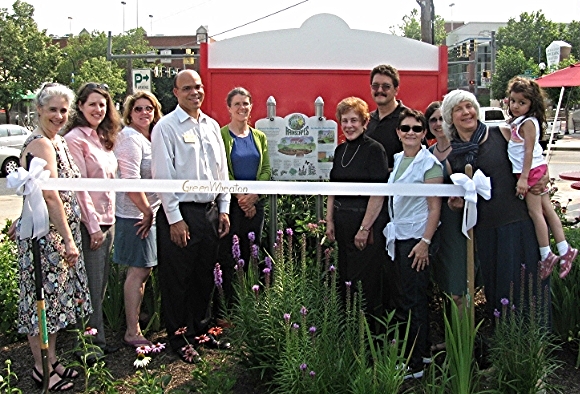
Volunteers from Green Wheaton and Friends of Sligo Creek team up to plant a community garden./Photo source: stormwaterpartners.org

Volunteers from Green Wheaton and Friends of Sligo Creek team up to plant a community garden./Photo source: stormwaterpartners.org

IT'S EASY BEING GREEN


For Ed Murtagh, environmentalism has been a lifelong journey.

“Over time, I’ve been inspired learning about all the opportunities we have to have to help the environment,” said Murtagh, one of the founders and original members of Green Wheaton, a nonprofit for environmental outreach, education and collaboration.

“Our goal is to promote our community as a model of green and sustainable living,” said Green Wheaton executive director Wendy Howard. “People here are stakeholders in their communities. Everyone wants to thrive. We’ve done some good things on our own, but the greater successes have always been when we’ve collaborated.”

Big Belly solar units in Wheaton, MD/Photo source: Green Wheaton

Big Belly solar units in Wheaton, MD/Photo source: Green Wheaton

A primary example of such success is the installation of 18 Big Belly solar dual trash and recycling compactors throughout the city of Wheaton. The units send a signal to the local CleanSafe team when they are full, saving both time and energy so sanitation workers don’t have to check each unit every day.

One of the original goals of Green Wheaton, Murtagh said, was to have an organized voice on why sustainability and green living is vital, in the midst of the city’s ongoing redevelopment project. “Green,” he said, can mean anything from buildings under LEED construction standards to energy efficient lighting to actual green spaces – parks and gardens.

“We want people to know this is a community that takes sustainability seriously,” he said.

“For me, personally, a greener Wheaton means there is a walkable place for me to go,” said Howard. “I want to be able to walk to the shopping. I want a place where I can meet my neighbors. I'd like to see a physical green space, a park. I want a place where I can bring my clients. I love to go to local businesses. It's a community that is environmentally friendly.” 


GARDENS FOR GOOD


Green Wheaton, said Howard, is a public/private partnership, which works in tandem with both local businesses and residents, and with governmental bodies, including the City of Wheaton, the Department of Environmental Protection and the Montgomery County Department of Economic Development.

“Having an organization is important for influencing elected officials,” Murtagh said.

The organization works to spread awareness of sustainable opportunities such as the emPOWER Maryland home energy audit, and to be watchdogs throughout the city revitalization.

“We are looking forward to (the redevelopment),” said Howard, “but we want to make sure it enhances the community. It’s great to have buildings come in, but we want to make sure we have green spaces.”

Launching a community garden in Wheaton/Source: Green Wheaton

Launching a community garden in Wheaton/Source: Green Wheaton

Green Wheaton created a community garden with a rainscape to reduce runoff.  A rainscape or rain garden, is a garden in a small depression, which can collect rainwater and use it to help plants grow. This not only prevents runoff, it also reduces water waste. Natural fresh water is used for garden plants, rather than from a hose or faucet. Water used inside the house can even be recycled via a sump pump.

“We’re learning to manage stormwater,” said Murtagh, “and trying to get people to use stormwater for gardens.”

An overview of the Montgomery County Department of Environmental Protection RainScapes Program, and the importance of good water runoff management practices for a healthy watershed. This video focuses on explaining what a rain garden is how it helps control water runoff, and how to put one in you own yard!

An increasing number of people, he said, are installing rain barrels in their gardens, thanks to the awareness and education being spread by the members of Green Wheaton.

The headwaters of Sligo Creek are in Wheaton, which makes runoff maintenance and creek restoration a vital part of Green Wheaton’s work. Stormwater runoff essentially means that dirty water (water that runs through streets, etc. collecting contaminants), gets pushed into the creek via storm drains. Installation of more rainscapes and rain barrels is helping to prevent runoff into the creek and restore the watershed. 


THE GREEN TEAM


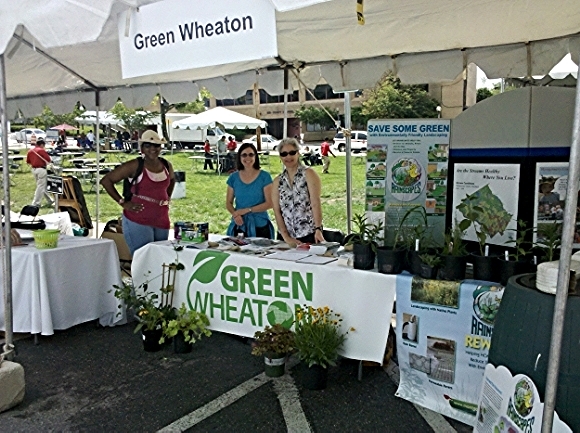
Green Wheaton representatives at Taste of Wheaton/Photo source: Green Wheaton

Green Wheaton representatives at Taste of Wheaton/Photo source: Green Wheaton

Green Wheaton sponsors community events, including public service days, paper shredding days for recycling, or community clean-ups. More than 100 people joined the efforts on Martin Luther King Service Day, Murtagh said. The group hosts a local gathering – Green Drinks – to bring together fellow green-minded neighbors.

“People need an organized effort to engage the public,” he said. “A few dedicated people working together can make a big difference.”

Local artist and photographer Joanne Miller recently received a grant from the Arts and Humanities Council of Montgomery County to lead a yearlong series of arts and nature walks in collaboration with Green Wheaton. 

Rainscape garden in Brookside Garden, Wheaton/Silver Spring/Photo by Holly Leber

Rainscape garden in Brookside Garden, Wheaton/Silver Spring/Photo by Holly Leber

For most events, said Howard, Green Wheaton has been able to partner with local business that are working to increase their green practices, including Hollywood East Café. Janet Yu, the owner of the dim sum café, has worked to increase energy efficiency, creating a business that is both more sustainable and more economically sound.

“A new project is to provide a specific resource to businesses, help businesses to make it easy to find out about resources and things they can do,” said Howard. “We're trying to take advantage of the information and knowledge we possess and give it out to everyone else.”

donate to green wheaton

About the Author: Holly Leber is the editorial director of the Daily Do Good. She, too, enjoys green spaces and loves to go to a local business.


In Environment/Outdoors
Comment

Scholarchips

June 9, 2016 Saranah Holmes
ScholarCHIPS being presented a $10,000 match grant by the Washington Redskins Charitable Foundation. Photo credit/ Sidney & Company

ScholarCHIPS being presented a $10,000 match grant by the Washington Redskins Charitable Foundation. Photo credit/ Sidney & Company

MAKING COLLEGE A REALITY FOR EVERYONE


Children of incarcerated parents are often held accountable for their parents’ decisions and left to deal with the harsh reality of growing up without a mother or father in the home.

ScholarCHIPS, an acronym for Children of Incarcerated Parents, was founded on the belief that these young people should be given a chance before being written off by society. The D.C.-based nonprofit exists to provide college scholarships, mentoring and a support network to youth with incarcerated parents, inspiring them to pursue and complete their college degree, according to ScholarCHIPS founder and executive director Yasmine Arrington. 

“It’s important to me that as many of these youth receive the opportunity to go to college and graduate,” Arrington said. “In the bigger picture, this is a solution to, and a sign of exiting, the War on Drugs era when so many people were sent to prison with lengthy sentences for non-violent crimes, leaving millions of youth without a parent, or sometimes without both parents, in the home.”

ScholarCHIPS was born out of Arrington’s, and her grandmother’s, frustration of not being able to find scholarships for children with incarcerated parents (Arrington’s father was incarcerated). This prompted Arrington to conduct her own research. In that moment she realized she wasn’t alone, that nearly three million youth in the U.S. have an incarcerated parent. 


THE STIGMA OF BEING A CHIP


For Raynna Nkwanyuo, a senior at Old Dominion University in Norfolk, VA and one of ScholarCHIPS’ first scholars, the organization has helped make pursuing her degree in public health and administration easier. It also helped her to break some of the stigma that comes along with having an incarcerated parent (her mother was incarcerated for five years) by meeting other youth in her predicament. 

“I’m very grateful for the organization,” Nkwanyuo said. “It’s provided me with a strong network and support system. Incarceration is a topic that’s rarely discussed. It gets swept under the rug, so I'm grateful that there's an organization that offers support to children of incarcerated parents." 

ScholarCHIPS founder and executive Director Yasmine Arrington (center) being honored at 2012's "Black Girls Rock" event.

ScholarCHIPS founder and executive Director Yasmine Arrington (center) being honored at 2012's "Black Girls Rock" event.

Besides seeing the joy and excitement on the scholars’ faces at the annual award ceremonies, one of Arrington’s proudest moments is being featured on BET’s “Black Girls Rock” event in 2012. 

“That’s when the nation was introduced to ScholarCHIPS,” Arrington said. “I received so much positive feedback from the show and many people still recognize me and the organization from that feature.” 


BREAKING THE CYCLE


ScholarCHIPS holds several fundraising events throughout the year, including auctions, benefit concerts and wine tastings. Additionally, it participates in several conferences related to children of incarcerated parents and reentry programs.

ScholarCHIPS being presented a $10,000 match grant by the Washington Redskins Charitable Foundation. Photo credit: Sidney & Company

ScholarCHIPS being presented a $10,000 match grant by the Washington Redskins Charitable Foundation. Photo credit: Sidney & Company

To date, ScholarCHIPS has awarded more than $30,000 to 17 scholars. Arrington’s mission is to increase that number each year in hopes that more youth will realize that college can be a reality for them.  

“When my scholars graduate, they’re breaking the cycles of intergenerational incarceration and poverty that continues to affect predominantly black and low-income communities,” Arrington said. “If given a chance, they can make some very positive, transformative decisions of their own. ScholarCHIPS is not only impacting individuals but their families, communities and ultimately, the nation.”

donate to scholarchips

About the Author: Princess Gabbara is a Michigan-based journalist and freelance writer (Ebony, Essence, etc.). You can read more of her work on her blog. She also tweets @PrincessGabbara.

In Youth/Education
Comment

Red Wiggler Community Farm

June 9, 2016 Saranah Holmes

TRANSFORMATIONS AT RED WIGGLER COMMUNITY FARM


In the early ‘90s, Woody Woodroof started an organic vegetable garden at the Arizona group home where he worked. In doing so, he was introduced to red wiggler worms, which are excellent for breaking down compost and transforming infertile soil into something conducive to growing food.

Woodroof was struck by the parallels between transforming soil and transforming people. He knew there was a need for more meaningful, connected, inclusive jobs for the disabled adults with whom he worked.

In 1996, Woodroof launched Red Wiggler Community Farm, a 12-acre certified organic farm in Germantown, in 1996. Sixteen adults with intellectual and developmental disabilities comprise the core crew.

“The metaphor (of the worms),” he said, “is about transforming people through job development, job skills, inclusion in the community - not about people's disabilities, but about what they do, what they produce.”

 Today, the mission of Red Wiggler is “to be a sustainable farm where people with and without developmental disabilities come together to work, learn and grow healthy food.”

“Everyone comes to the table with skills,” Woodroof said. “Find out what they’re good at, focus on those things. Here, some people are really good at one thing. We also try to push their edge a little bit by challenging them to do a couple of other things.”


GROWING TOGETHER AT RED WIGGLER


Staff members have yearly meetings with their employees’ vocational helpers and family members to evaluate their progress and to set goals for the following year.

“Each of the growers have some goals for the year,” said Katie Junghans, Red Wiggler’s volunteer and grower coordinator. “Some times it has to do with learning a new tool or getting better at using a certain tool, like a hoe, or learning how to wheel a wheelbarrow.”

The desire to challenge the workers can present its own challenges. One, Woodroof noted, is content to weed all day every day.

 “As an organization we’ve had to wrestle with that a little bit,” he said. “We want to focus on people's abilities and what they’re good at and like doing, but is it fair to her to not encourage her to learn new skills?”


VOLUNTEERISM & LEARNING AT RED WIGGLER


Red Wiggler relies heavily on volunteer participation not only for production, but for mutual learning opportunities.

 “By having folks working side by side and often pairing people up, they’re both learning from each other,” said Molly McCracken, education and outreach coordinator. “A lot of youth have never experienced working with someone with developmental disabilities and have a lot of different kinds of preconceived notions about what that might be like or what the person might be capable of.”

On a September morning, staff members worked alongside a half dozen volunteers from a nearby engineering firm.

“Through the volunteerism, it’s a very included environment,” said Woodroof. “You often don’t know who’s got a disability and who doesn’t. Our role is to set (the growers) up as teachers and mentors.”

The experience can be especially transformative for the younger volunteers.

Last year, one enthusiastic intern got the National Honor Society at her high school to adopt the farm as their charity. Every holiday last fall, she brought a group of kids out to do some volunteer work.

That young woman is currently studying agriculture at Cornell University.

“She’s really kind of had her whole plan for her life changed from being here,” Junghans said, “It’s just amazing the few that really just take to it so much and kind of adopt us and keep coming.”

donate now

About the Author: Terri Carr is a Washington, DC yogi and writer. She blogs at Yoga Soulutions.

In Jobs & Workforce, Environment/Outdoors
Comment

Earth Conservation Corps

June 9, 2016 Saranah Holmes

ENVIRONMENTALISM AND EMPOWERMENT


The mission of Earth Conservation Corps, said executive director Mafara Hobson, is “pretty powerful.”

“We work with at-risk youth and help them reclaim their lives by reclaiming the Anacostia River and their community.”

Since its founding in the early 1990’s, the ECC has strived to engage underserved DC youth in self-empowerment through environmental stewardship.

“We see opportunity between the effort to save the endangered Anacostia River and the need to engage the young men and women who live in the neighborhoods along its banks,” wrote founder and co-chairman Bob Nixon in an open letter on the organization’s website.

Nixon, a film producer, started ECC after coming to DC to shoot a film about environmentalism. He stayed because he saw a desperate need.

“They didn’t just dump trash here,” Nixon told PBS’s Bill Moyers in a 2007 interview, “they dumped people here.”

Despite a rising real estate and commercial business market, the Anacostia neighborhood, and others in Wards 7 and 8, have been plagued by crime and high dropout rates. Unemployment in Ward 8 once measured the highest in the United States. While numbers have greatly improved in the past five years (11.7 and 14.1 percent, as of June 2015, down from 21.3 and 25.2 the same month in 2011), unemployment in Wards 7 & 8 are higher than the District rate of 6.9 percent, and higher still than the U.S. rate at 5.3 percent. 


RISING ABOVE, SOARING HIGH


Earth Conservation Corps challenges students to rise above statistics by providing the means and motivation to pursue a brighter future, for the community and for themselves.

“It empowers them to take charge of their own lives, and not just be another unemployment statistic or victim of violence, or someone participating in activities that aren't constructive,” Hobson said. “They can be and do whatever they want to do.”

The members of the Corps, 20 each year, must commit to 1700 hours of environmental work each year. 

Earth Conservation Corps programs expand beyond restoring the river itself.  ECC has paired with the Environmental Protection Agency on a water monitoring effort, and with the DC Office of Environment and Energy to restore the tree canopy in the Anacostia watershed.

60 Minutes features the Earth Conservation Corps

“It helps create an ecosystem in communities where there’s a dearth of conservation,” Hobson said. 

Other programs include a wetlands restoration project, and a raptor conservation effort. Nixon and the ECC have been instrumental in reintroducing bald eagles to the District, bringing 16 eagles to the nation’s capital between 1995 and 1998. Today, according to an article from the National Wildlife Foundation, about 6 bald eagles and 16 osprey nest along the Anacostia. A live osprey camera is trained on a nest beneath the Frederick Douglass Bridge. 

“That shows the progress on the Anacostia. We want the same for the community members,” said Sarah Nixon, board member and wife of founder Bob Nixon. 


MAKING CHANGES, TAKING CHARGE


Sadly, the birds have fared better than some of the young men and women. “There's a wall dedicated to the Corps members who have lost their lives,” said Nixon, “to happenstance of where you live and where your resources are.”

Angered by the manner in which their fallen compatriots were being overlooked by the DC community at large, ECC Corps members, alongside Bob Nixon, created a documentary called “Endangered Species,” about the plight of urban youth.

But other students have been lucky. Rodney Stotts was an early Corps member. Before the ECC, he dealt drugs on the streets of Anacostia.

“You can’t feel good about anything you have,” he told 60 Minutes, “because it was ill-gotten gains.”

Stotts was not available for comment, but both Hobson and Sarah Nixon spoke of him as an exemplary Corps member. Now a master falconer-in-training, Rodney oversees youth programming at Wings Over America, and maintains an active relationship with ECC as a mentor and advisory board member.

“ECC is about taking ownership and responsibility of your community,” said Hobson. “A lot of kids don't feel empowered to take control of their lives. Whatever happens, happens. Through the program, in having a responsibility to the community, they realize ‘if I can make environmental changes in my own community, I can also make significant changes in my own life. If I can make changes in my community, I can also make changes in myself.’” 

donate to ecc

About the Author: Holly Leber is the editorial director of the Daily Do Good, and a freelance writer and editor. 

In Environment/Outdoors, Youth/Education
Comment

FRESHFARM Markets

June 9, 2016 Saranah Holmes

KEEPING IT FARM FRESH WITH FRESHFARM


On a chilly January morning in Silver Spring, Julie Stinar is making a deal: Beef for bread.

“We do a lot of trading around here,” Stinar, owner of Evensong Farms, said of her fellow vendors at FRESHFARM Markets.

FRESHFARM began as a single farmers market in 1997. Nineteen years later, it’s a thriving nonprofit with 11 markets, including two year-round, and multiple nutrition assistance, education and business development programs. But FRESHFARM’s primary goal is to support the people who make it all possible: The farmers.

Evensong Farm herbs/Photo by Holly Leber for Paste

Evensong Farm herbs/Photo by Holly Leber for Paste

“We are all about the supply side in the food movement,” said executive director Mike Koch. “We’ve long been dedicated to providing economic opportunities to farmers and producers.”

A FRESHFARM program that helps provide those opportunities is the Jean Wallace Douglas Farmer Fund, a scholarship program for growers and producers.

Stinar has benefited from the Farmer Fund to attend the Pennsylvania Association for Sustainable Agriculture Conference.

“Every time I learn different things,” she said. “Last time I was focused on business plans related to agriculture, as well as herb production.”

In addition to grass-fed beef, chicken and pork, Evensong offers homegrown herb lemonades three seasons of the year.

FRESHFARM is dedicated to making the public aware of the importance of local food from environmental, food security, health perspective and economic perspectives.

“Everybody should have the right to do a job that they love to do,” said marketing manager Nikki Warner. “Farmers don’t farm because it’s a profitable business; they love to cultivate the soil and nourish their families. That’s their American dream. If there’s no way for them to be economically viable, we have to rely on the industrialization of food.”

“There’s something greatly unfair about those who grow our food and ensure we have a table that’s filled having a hard time guaranteeing they’re making a living,” added Koch.

The FRESHFARM team helps promote this awareness and appreciation of locally grown food from a young age through FoodPrints, a partnership with DC Public Schools that integrates gardening, cooking and nutrition lessons into the students’ curricula.

“The food environment that our kids are growing up in is pretty horrendous,” said Jennifer Mampara, FRESHFARM’s director of education. “If you look at the messages, they’re pretty horrendous. The foods that are being advertised to them are not the foods they need to eat.”

Another issue is access – public school children in DC often come from the city’s so-called “food deserts,” where fresh produce is not readily available.

“So many kids live in neighborhoods where they don’t have access to full-service grocery,” continued Mampara. “It’s so much cheaper to buy a soda and a bag of potato chips. We want to offer a counter to those messages and offer something meaningful and hands-on.”

FRESHFARM also works to help combat the food deserts through gleaning partnerships with other area organizations, including DC Central Kitchen and Miriam’s Kitchen, and nutrition assistance SNAP and matching dollars programs.

“Not only does it benefit the shopper, but the farmer gets sales from a client who would not otherwise shop at the farmers market,” Warner said.

At present, FoodPrints exists in six schools – five in Ward 6 on Capitol Hill, and one in Ward 2 near Foggy Bottom. Next year, two schools in Wards 7 and 8 will be added. FoodPrints began with a $5000 donation from a market customer who requested only that an education program for school children be established.

The FRESHFARM staff members say they observe children who have a chance to help grow vegetables and create healthy meals appreciating fresh food in a way they might not otherwise, even if they begin with a sense of apprehension. Mampara recalls one child who confided that she was “allergic” to the kale salad the class was making.

At the end of class, Jennifer said, “I looked over and she was gobbling it down, and she said ‘it turns out I’m not allergic to kale anymore!’”

(Unless otherwise indicated, all photos have been provided by FRESHFARM Markets.)

donate now

About the Author: When Holly Leber isn't running editorial for the Daily Do Good, she enjoys spending all her money at farmer's markets. More publishers should pay her to write stories about said markets, so she can continue to support the farmers. 

In Environment/Outdoors, Jobs & Workforce
Comment

A Space of Her Own

June 9, 2016 Saranah Holmes
A SOHO mentor and student work together/Photo source: Patch.com

A SOHO mentor and student work together/Photo source: Patch.com

SOHO GOES FULL STEAM AHEAD


Imagine a year filled with fun arts and crafts, yummy food, community service, and individual support from a friendly mentor, all culminating in—drumroll please—a room makeover to create a new space just for you in your very own home!

A Space of Her Own (SOHO) offers all of this to at-risk pre-teen girls in Northern Virginia. A Space of His Own, for boys, is also offered at Jefferson-Houston Elementary School.

“I’m happy to work here every day,” saidLily Rowney, VISTA Mentor Program coordinator.

A SOHO student and mentor work on a lamp/Photo source: Patch.com

A SOHO student and mentor work on a lamp/Photo source: Patch.com

SOHO provides mentorship and skills-building to at-risk girls and boys in grades five through seven. It began in 2002 as a partnership between Alexandria’s Juvenile Court Service Unit and the Art League as a way to counter rising youth crime rates.

What started as an intervention program, diverting preteen girls who had started getting into trouble, has since become a means of prevention, engaging 48 youth per year before they start going down the wrong path. Since its inception, the organization has served 212 students with a 98 percent success rate, meaning the students have not been become involved in the court system.


GIVING GIRLS A SPACE


SOHO Mentors, said Rowney, undergo three 2.5-hour training sessions. To date, SOHO has screened and trained more two hundred mentors. The current class is a diverse group of professionals, most of whom have advanced degrees.

Because the majority of program participants are African-American, Hispanic or from immigrant households, training includes cultural sensitivity components as well. Rowney described a recent instance in which a participant’s family spoke only Spanish, whereas the mentor did not speak any. Neither party let that stop them, and through the course of the year, they used broken English and Spanish to push through the language barrier for the benefit of the student.

The program provides the students not only with meals, supportive mentors, life skills and a creative outlet, but also a very tangible aid for their academic success: A space of their own with adequate room and lighting for their studies. Many SOHO participants are living in overcrowded environments with their families.

In the spring, students and mentors renovate a space in the students’ homes in partnership with SOHO’s sponsors.

If you’re feeling inspired, it’s not too late in the year to get involved. SOHO is still accepting new volunteers, and will have trainings in January and February. In addition, SOHO will be one of the featured organizations at A Night of Firsts, organized by the Alexandria Mentoring Partnership. The program on January 20 from 6:00 to 8:00 pm at the Charles E Beatley Central Library will feature mentors and mentees telling their mentoring stories.

donate now

Tara Campbell is a D.C.-based writer of crossover sci-fi, dreaming up new stories in a space of her own.

In Women, Youth/Education
Comment

The Farm at Our House

June 8, 2016 Saranah Holmes

THE FRESHEST FARE


Marc Grossman’s first experience working on a farm was in Ohio, when he was in his early 20's. Although he loved to cultivate the land, it didn’t seem like a viable career option. Fast forward a couple of decades, and Marc is the co-owner of the Farm at Our House, an organically-certified vegetable farm that harvests fresh produce in Brookeville, Maryland.

The 12-acre farm, which started in 2002, is located on the property of Our House, a residential job-training center for at-risk teenage boys. The farm provides produce to local restaurants and members of its Community Supported Agriculture (CSA) program.

Marc believes that local farming is a win-win for farmers and consumers: “Local farming provides people in the community with a sense of hope," he said. "People are looking for ways to grow food in a more ecological manner, while enjoying the benefits of fresh, local foods.”

CSA members are able to participate in special harvest celebrations and to volunteer on the farm along with the farm’s staff and the young men from Our House.

“Farming is something that people can come together around. It’s not just about learning how to farm, or working really hard,” Marc asserted. “It’s about having a common goal and doing something really tangible and really productive.”

The farm has three harvests throughout the year—in spring, summer, and fall. Produce pick-ups run from May through November.


BOYS TO MEN


If nature is therapeutic and hard work transformative, then Our House is the ideal place for young men in Brookeville, Maryland who want to transform their lives. The residential facility boasts rolling hills, a pond, swamp, and a host of wildlife—including a beehive and volunteer beekeeper. The residents, who come from social service agencies and correctional facilities, seek to redefine themselves and gain the skills necessary for life-long success. 

Over the course of their stay at Our House (which ranges from a few months to a couple of years), the young men receive job training, professional counseling, life skills workshops and GED preparation. But they don’t just receive; they give back. All residents volunteer in their local community to deepen their sense of responsibility and connection to it. 

In alignment with Stephen Covey’s book, The Seven Habits of Highly Effective People, OH seeks to “begin with the end in mind.” Residents maintain a strict schedule to develop discipline, a solid work ethic, and can experience the fruit (literal and figurative) that comes from working consistently and diligently over time. The Farm at Our House, a separate entity, offers residents the opportunity to learn how to plant and harvest fruits and vegetables.

“It was real rough going at first,” explained Ed Gould, the long time OH volunteer who started the farm. “They were not too enthusiastic—you don’t get a return for several months—but eventually there was enough land tilled and ability to grow things that the guys made a few hundred dollars.”

Gould argues that the farm and the house provide space for transformation to take place. “When some guys are there because they assaulted someone and are there to deal with their anger, they are going to do that. That they are willing to reveal that to me—that admission is the first step toward their own healing.”


SWEET APPLES: A VOLUNTEER’S PERSPECTIVE


Three years ago, a neighbor recommended that Amie Myers join the CSA program at the Farm at Our House. Eager to go organic, Amie joined and began to volunteer just a year later. Today, she volunteers a few hours a week, in exchange for the opportunity to pick fresh produce for the week, free of charge. 

“I feel so lucky to be able to volunteer at the farm,” Amie beamed. “Once I get there I’m always happy, and then I go home with a bounty of local, fresh organic food. You just can’t beat it!”

Amie shared her top eight reasons for why she prefers the farm fresh fare:

  • The greens are deeper.
  • The apples are sweeter.
  • Everything is so fresh. It may have just been picked that day.
  • Things are able to ripen on the vine, instead of being picked early and shipped.
  • It prevents a lot of carbon emissions. It’s important for me to reduce my impact.
  • I cook, every day, with fresh food.
  • I like to make pretty easy things. I have a whole basket of six different varieties of squash right now. I’m enjoying thinking of all the things I’m going to do.
  • Every week, the food is amazing!
donate now

About the Author: Chanté Griffin is a writer. In her dreams, she is a certified organic specialist who harvests all of her own veggies in her backyard, but in reality her solitary rosemary plant died. Tweet with her: @yougochante

In Youth/Education, Environment/Outdoors
Comment

Food Recovery Network

June 8, 2016 Saranah Holmes
Food Recovery at UMD College Park/Photo by Jason Souder

Food Recovery at UMD College Park/Photo by Jason Souder

THIS IS CRAZY


The United States Department of Agriculture estimates that about 90 billion pounds of edible food go to waste each year.

Crazy, right?

Food Recovery Network  thinks so too, and they’ve gotten way past the goggle-eyed disbelief stage. They’re digging in to solve the problem — digging in to leftovers in university kitchens around the country to reclaim food that would otherwise be thrown away at the end of each day.

Since its beginnings at the University of Maryland, College Park in 2011, FRN has grown to a network of 155 campus chapters in thirty-nine states that have recovered almost a million pounds of food to date.

The group became a formal non-profit in 2013 with help from the Sodexo Foundation (yes, college cafeteria survivors alums, that Sodexo). In 2014, FRN collected more food than in the previous three years combined. By May 2016, they plan to be on 180 campuses and have recovered 1.2 million pounds of food.

“America is ready to change,” said FRN Executive Director Regina Northouse. After many years in the social justice arena, Northouse is relatively new to FRN, but she’s already noticed a difference in how people respond to her current mission. “My network has always been happy to help with my work, but the amount of care and support they have shown for FRN has been amazing. People want to volunteer, they want to learn more.”
 

ONE PERSON AT A TIME, ONE POUND AT A TIME


It happens one student and one pound at a time. Every evening, volunteers arrive at campus kitchens across the U.S. to recover food in a careful process that involves checking food temperature for safety, weighing and repacking the food, and delivering it to area organizations in need. DC-area chapters partner with the Christian Life Center in Riverdale, Family Crisis Center in Brentwood and the Central Union Mission, in DC.

At UMD College Park, collections happen most nights at 9:45, whereas another campus in the network has to pick up at 6:00 a.m. on Saturdays. These times are anathema to most college students, but FRN students are committed, and together they make a difference.

Food Recovery at Lycoming College, Williamsport, Penn./Photo by Jason Souder

Food Recovery at Lycoming College, Williamsport, Penn./Photo by Jason Souder

The time, it seems, is right for food justice.

So what’s been stopping us before? Sara Gassman, FRN’s Director of Member Support and Communications, cites misinformation as one of the most common barriers to food recovery.

“Not everyone is aware of the Good Samaritan Act, which protects donors acting in good faith,” she said. The policy, enacted in 1996, protects food donors from liability when they have followed all measures to keep food donations safe from collection through delivery. “Another difficulty is that there are no national guidelines for what’s acceptable to be recovered. We have to research a lot of health codes.”

But for Gassman, who describes her involvement with FRN as “eye-opening,” all the work pouring through arcane local regulations is worth it when she gets to engage with students at regional and national conferences.

“It’s a chance to meet and see that we’re all part of something bigger than ourselves. We’re really facilitating change in the way people view food surplus.”
 

CHANGING BEHAVIOR


Food Recovery at UMD College Park/Photo by James Souder

Food Recovery at UMD College Park/Photo by James Souder

This transformation isn’t limited to university campuses. FRN’s Food Recovery Certification program provides recognition for companies that donate food, and information for companies that want to start. There are currently sixty-five FRN Food Recovery Certified companies in this one-of-a-kind program.

December 1 is Giving Tuesday. For Food Recovery Network, it will be the culmination of a month-long campaign: #FRNDZY. It’s a friendly competition among national chapters to raise $20,000 and develop students’ fundraising skills. Prizes for winning chapters include trips for students to attend FRN’s National Food Recovery Dialogue in April 2016. And every dollar donated during this campaign will be matched by Newman’s Own Foundation.

Working with student organizations was her primary focus when she arrived, but since learning the food waste facts, Gassman said has started looking more closely at her own consumption. “Now when I’m at the store, I think twice before I buy something. ‘Do I really need it; will I have time to cook it?’ This work has definitely influenced my personal behavior.”

It’s also changed her friends’ behavior. Now, she said, when they’re out to dinner and they finish their plates, they proudly announce, “Look, no food waste.”

She’s happy to get people thinking about their relationship with food. “All it takes is one person.”

Students recover food after a football game/Photo credit: The Washington Post

Students recover food after a football game/Photo credit: The Washington Post

donate now

About the Author: Tara Campbell is a crossover sci-fi writer living in Washington, DC. She volunteers her time for literacy organizations such as 826DC and the Books Alive! Washington Writers Conference. Follow her on Twitter at@TaraCampbellCom.


In Youth/Education, Hunger/Homelessness
Comment

DC Web Women

June 8, 2016 Saranah Holmes
Volunteers lead a coding workshop/Photo credit: DC Web Women

Volunteers lead a coding workshop/Photo credit: DC Web Women

WOMEN WHO WEB


Who runs the web? Girls!

So why does society, women included, continue to think that science, technology, engineering and math (STEM) fields are reserved for men only?  

Most children become aware of gender roles early on and, subconsciously, those perceived norms can influence the goals and limits they create for themselves.

Toys often reinforce some of the gender stereotypes that exist. In 1992, Mattel released a Teen Talk Barbie whose lexicon included the phrase, “Math class is tough!” It was largely criticized and eventually pulled from shelves.

Fast forward 23 years, and women are still underrepresented in STEM fields. In fact, only 30 percent of women work in the tech industry, according to a CNET article published earlier this year.  

Fortunately, DC Web Women exists to promote women and girls in technology according to its website.

DCWW started off with a handful of women who would meet in a coffee shop to discuss all things tech. Twenty years later, it is more than 3,000 members strong. Many of DCWW’s members specialize in social media, search engine optimization, web analytics, e-marketing, graphic design and web development.

“Our founders wanted to create an inclusive space for women to come together to talk about tech,” said DCWW President Sibyl Edwards. “While things have improved for women in tech since 1995, the reality is there are a lot of women who are still not entering the field and those who do enter the field drop out at some point. So, there’s still very much a need for groups like DC Web Women.”

To help spread the mission and attract new members, DCWW’s leaders have developed several initiatives, including Girls Rock on the Web. Here, girls ages 8-12 learn more about technology in the hope that they girls will gain interest in STEM fields. 
 

TECH THE HALLS


Within the past year, DCWW has made an effort to revamp its Outreach Committee by placing a stronger emphasis on young girls and minorities. As a result of partnering with several local STEM organizations, DCWW has managed to reach more than 400 children this year alone.

“[Our goals include] increasing the number of women in their particular field, empowering women and girls to pursue high-paying jobs in technology, and [changing the ratio of women and girls in tech],” said DCWW volunteer Ashley Holtz. “The outreach team is an integral part of DCWW and its mission. If girls are not aware of STEM careers and are not encouraged to pursue them, we will never improve the number of women in tech fields.”

Tech the Halls 2013/Photo credit: DC Web Women

Tech the Halls 2013/Photo credit: DC Web Women

DCWW works to ensure that women who are currently in tech feel supported, while girls who may be interested in tech have the proper resources they need. However, the ladies at DCWW also know how to let loose and have fun once in a while. Tech the Halls, an annual holiday party that celebrates the DC tech community, is DCWW’s biggest event of the year.

“It’s more of a networking event since there are around eight different tech groups that usually join us. You don’t have to be a member of DC Web Women or any of the groups represented to attend – anybody can go,” Edwards said. “We’ve found that a lot of people find out about DC Web Women through Tech the Halls because it’s become so popular.” 

For Edwards – and the rest of her colleagues for that matter – being a part of the DCWW team is more than just a job. Prior to becoming DCWW’s president, Edwards worked as a volunteer at different levels of the nonprofit.

DC Web Women (and a few men) exchange ideas/Photo credit: Bri Monet/DC Web Women

DC Web Women (and a few men) exchange ideas/Photo credit: Bri Monet/DC Web Women

At a time when Edwards felt isolated as a tech woman, DCWW granted her the opportunity to meet other women in the industry that she could relate and connect to. She’s now on a mission to inspire a new generation of women and girls to not only rethink their role in technology but make their mark on it as well.

“The reason I’ve stayed with DC Web Women for as long as I have is because of the simple fact that it continues to contribute to my life,” she said. “When I first entered the tech industry, I didn’t have any mentors, so DC Web Women has been a way for me to give back to other women in tech.”

donate now

About the Author: Princess Gabbara is a Michigan-based journalist and freelance writer (Ebony, Essence, etc.). You can read more of her work on her blog. She also tweets @PrincessGabbara.

In Women, Jobs & Workforce
Comment

Place Thru Culture

June 8, 2016 Saranah Holmes

LEARNING AT HOME AND ABROAD


“I know about Peace thru Culture.  I went to Costa Rica and learned about steam energy from the volcano.  I am going to study engineering because I want to know how to make energy from steam.” - James, Benning Terrace Housing Community, Global Trek Costa Rica in 2009

If you ask Adriane Alfred, founder of Peace thru Culture, this testimonial from their website says everything about the goals of the organization. Alfred started the non-profit in 2006 to give under resourced kids a chance to learn about different cultures and life options they wouldn’t otherwise have the opportunity to experience. Working primarily with schools in Wards 5, 6, 7 and 8, PtC offers intercultural programming in DC as well as travel experiences to various countries in the Americas.

And the kicker: Through grants and donations, they’re able to offer this programming at a nominal fee—in some cases, even free of charge.

The learning begins at home with culture camps during the spring and summer breaks. Each camp is two weeks long, and campers ages 8-12 can expect a full day experience tailored to specific age groups. The mornings start with breakfast and a warm-up like yoga or reading. Activities to follow include journaling, cultural introduction, and classes in the art, music, dance, and cooking of various cultures (yes, with a chef!). Breakfast, lunch and snacks are provided in partnership with the free DC lunch program.

And how does a $25 price tag for a two-week camp strike you? This low registration fee puts an intercultural experience within reach for all students, expanding their outlooks and futures. “These kids have never been anywhere,” said Alfred. “By exposing them to different things, they will be able to make different choices.”

Peace thru Culture also promotes cultural learning through overseas trips. Destinations include Panama, Costa Rica, Peru, Canada (Quebec), Puerto Rico, Martinique and Argentina. With a maximum of sixteen participants on each trip, PtC creates meaningful, interactive experiences rather than mass onslaughts of tourists. In addition to the introduction to art and history that most programs offer, PtC also provides daily language instruction, cultural programming and immersion into local communities, as well as visits to areas of scientific/ecological interest. 


SUSTAINABLE ME, SUSTAINABLE US


The group’s Sustainable Me! programming exposes participants to sustainable tourism (a subject Alfred teaches at George Mason University) and earth sciences. Costa Rica travelers, for example, visit sustainable farms in the mountains of Heredia and learn about energy production at the Miravalles volcano, site of the largest developed geothermal field in Costa Rica. They also spend part of a day with a local host family, sharing a meal with them and joining them in normal family activities.

Tours also have a service component, such as working with ADE (Association for Development through Education) in Costa Rica to help rebuild the community of Vera Blanca after the devastating 2009 earthquake.

Engaging local partners is important to Alfred. This not only provides students a more authentic introduction to the countries they visit, but also embodies sustainable tourism by ensuring that the resources go directly to the country visited rather than an external company.

Service and exposure to the community is key to the goal of the program: to show participants other cultures and ways of life. One of the most eye-opening tour segments has been the visit to the San Blas Islands in Panama, known locally as Kuna Yala.

“It’s real immersion for our students,” Alfred explained. “There’s no running water, they sleep in huts and get to spend time with Kuna youth. It’s real immersion.”

Despite the rough conditions, the kids love the program. “The experience gives them perspective,” said Alfred. “They realize they have more back home than they thought.”

donate to Peace thru Culture

About the Author: Tara Campbell is a DC-based writer of crossover science fiction. She’s lived in Germany and Austria, but never in a hut or next to a volcano.

In Youth/Education
Comment
← Newer Posts Older Posts →

HOME     SUBSCRIBE     BLOG     ARCHIVES     Testimonials     CONTACT


support DDG

Stealing isn't a good look for you.  ©Do Good, LLC. All rights reserved